
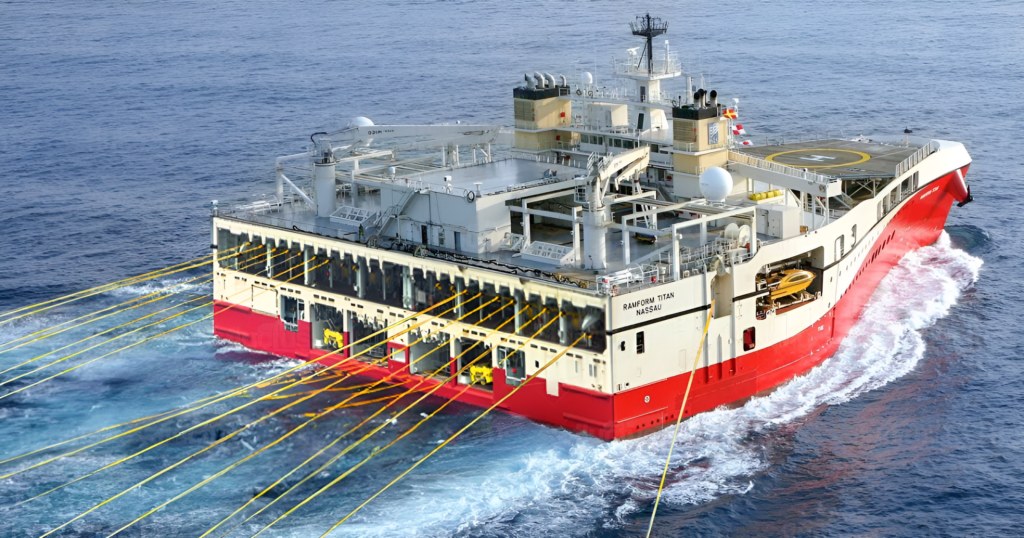
Ultra-high-resolution seismic (UHRS) surveys play a critical role in offshore wind site investigation by providing detailed subsurface imaging of shallow geological conditions. For developers, engineers, and project stakeholders, this level of insight supports better decisions during planning, foundation design, cable routing, and construction risk assessment.
As offshore wind projects move into more complex environments and tighter development schedules, UHRS data helps reduce uncertainty and improve the technical basis for investment and execution. The result is a more efficient site characterization process and a stronger foundation for safe, cost-effective project delivery. For related seabed surface insight, see our article on how side scan sonar supports site investigation surveys for offshore wind farms.
What UHRS surveys reveal
UHRS seismic surveys are designed to image shallow subsurface features with a level of detail that conventional seismic methods may not provide for near-surface interpretation. In offshore wind applications, this can include sediment layering, buried channels, boulders, shallow gas, faulting, scour-related conditions, and other geohazards that may influence engineering decisions.
Key technical outputs
- Detailed shallow stratigraphic interpretation
- Identification of near-surface geohazards
- Improved understanding of sediment variability
- Support for foundation and cable corridor planning
Project value
- Reduced design uncertainty
- Better risk allocation and mitigation
- More informed survey integration
- Stronger confidence during project development
Benefits for offshore wind development
High-quality shallow subsurface data helps teams identify constraints early, refine engineering assumptions, and reduce avoidable risk before construction begins.
One of the main benefits of UHRS surveys is the ability to improve confidence in site conditions at an early stage. This is especially important for offshore wind developments where foundation selection, installation methods, and cable routes depend on a clear understanding of shallow geology. Better data supports better engineering, and better engineering supports more reliable project outcomes.
UHRS surveys also help identify localized anomalies that could affect constructability or long-term asset performance. When integrated with geotechnical, bathymetric, and environmental datasets, the seismic interpretation becomes a valuable part of a broader ground model used across multiple workstreams.
Supporting risk reduction and design efficiency
For project teams, the commercial value of UHRS data is closely tied to risk reduction. Early identification of subsurface constraints can help avoid redesign, reduce installation surprises, and improve contractor preparedness. It can also support more targeted geotechnical campaigns by focusing investigation efforts where uncertainty is highest.
In practical terms, this means fewer assumptions, better alignment between survey disciplines, and a more robust basis for engineering decisions. In a sector where offshore execution costs are significant, even modest improvements in subsurface understanding can create meaningful value. This broader context is explored further in our post on offshore wind site investigation and expert consultants.
Why expert interpretation matters
The benefit of UHRS seismic surveys depends not only on data acquisition quality but also on experienced interpretation. Offshore wind site investigation requires technical judgment that connects geophysical observations with engineering relevance. Interpreters must understand how shallow geological features translate into project constraints, design inputs, and risk considerations.
Working with experienced consultants helps ensure that survey outputs are practical, decision-oriented, and aligned with the needs of developers, engineers, and project managers. This improves communication across disciplines and strengthens the overall value of the site investigation program.
Conclusion
UHRS seismic surveys are a powerful tool for offshore wind site investigation because they provide the shallow subsurface detail needed to support safer design, more efficient planning, and stronger risk management. As offshore wind projects continue to scale in complexity and ambition, high-resolution geophysical insight remains essential to building reliable project outcomes.
For organizations seeking to improve survey outcomes and interpret subsurface conditions with confidence, expert-led UHRS survey support can make a measurable difference across the project lifecycle.